
Scoliosis Care in Mission Viejo, CA - Chiropractic & Corrective Exercise
A curve that is measured precisely, tracked over time, and actively worked on.
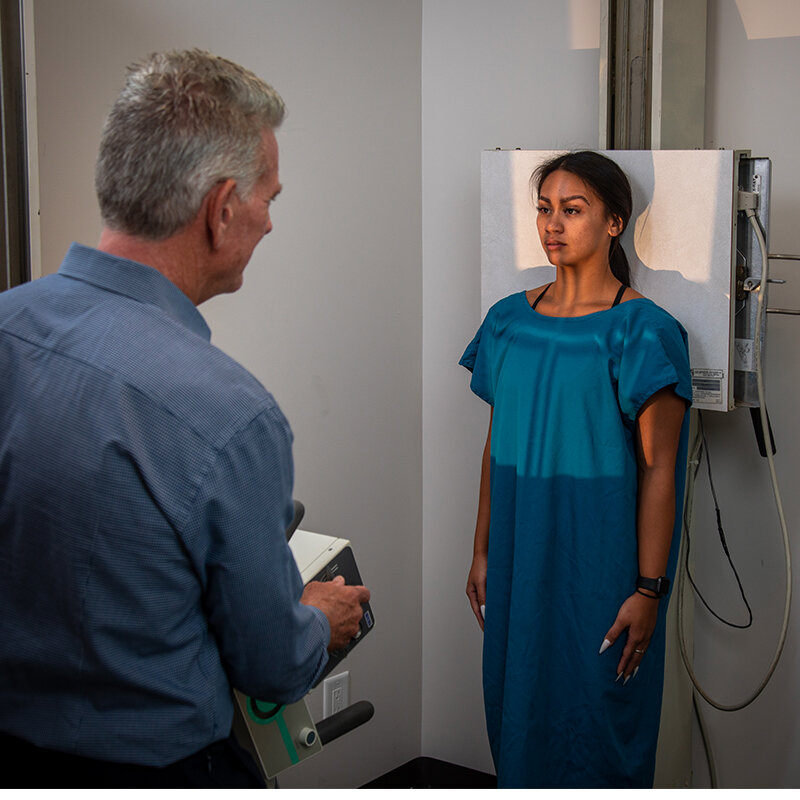
Scoliosis is a sideways curvature of the spine, usually diagnosed in adolescence but frequently carried into adulthood where it drives back pain and uneven loading. At Foudy Chiropractic in Mission Viejo, scoliosis is measured on digital X-ray and dual postural scales rather than estimated, and addressed with chiropractic adjustment, vibration platform therapy, intersegmental traction, and a corrective exercise programme built by Melanie L. Foudy, M.S. Chiropractic care does not straighten a structural curve, but it can improve function, reduce pain, and slow progression.
What it feels like
If several of these sound like you, they are worth measuring rather than guessing at.
- Uneven shoulders or hips
- One shoulder blade sticking out further than the other
- Clothes that never hang evenly
- Back pain that worsens through the day
- A curve diagnosed as a teenager that nobody has looked at since
- Fatigue from standing or sitting upright
| Relief | Correction | |
|---|---|---|
| Goal | Quiet the symptom | Address the cause |
| Typical length | A few visits | A course of care, then maintenance |
| What is included | Adjustment and modalities | Adjustment, modalities, and corrective exercise |
| Re-testing | Not usually | Progress exam against your own baseline |
| Likelihood it returns | Higher | Lower, if the exercise work is done |
What this means for you: both are legitimate choices, and Dr. Foudy will not push you toward the longer one. You just make the choice knowing which one you picked, and what it does and does not buy you.
Measured precisely, then tracked
Dual postural scales detect whether you are weight-bearing more to one side. Head tilt, shoulder level, and pelvic rotation are assessed. Digital X-ray shows the actual curve and lets it be measured properly.
That matters because scoliosis care is judged on whether the numbers move. The progress exam re-measures against your own baseline.
What actually helps
Vibration platform therapy assists with scoliosis reduction and reduces pain and inflammation. Intersegmental rolling traction addresses the muscle guarding that builds on the concave side. Adjustment restores motion to segments that have stopped moving.
The corrective exercise half matters more here than almost anywhere else. Melanie's programme targets the specific muscle imbalances a curve creates, which is the part that determines whether progress holds.
Be clear about what this is: chiropractic care does not straighten a structural curve. Severe or rapidly progressing curves belong with an orthopaedic specialist, and Dr. Foudy will refer you.
In summary: scoliosis at Foudy Chiropractic
- What it is. A curve that is measured precisely, tracked over time, and actively worked on.
- How it is found. Surface EMG reads nerve-root function level by level, digital X-rays show the structure, and palpation validates both - so the cause is measured rather than guessed at.
- How it is treated. Chiropractic adjustment, the open-floor modalities, and where discs are involved, AccuSpina spinal decompression. Corrective exercise follows so the correction holds.
- What it costs. An adjustment visit is $90 with every modality included. Decompression plans are quoted in person after your exam.
- Where. Foudy Chiropractic, 28892 Marguerite Pkwy #150, Mission Viejo, CA 92692 - (949) 365-0403.
Scoliosis - questions people ask
Can chiropractic cure scoliosis?
No, and anyone claiming otherwise is overselling. Chiropractic care can improve function, reduce pain, address the muscle imbalance a curve creates, and in some cases slow progression. A structural curve does not straighten out.
Is it worth treating scoliosis in an adult?
Often yes, because adult scoliosis pain usually comes from the compensations rather than the curve itself, and compensations respond well to care.
Do you treat adolescents?
Yes. Dr. Foudy sees patients of all ages and matches technique to the patient. Adolescent curves also need monitoring for progression, which is what the measured exam is for.
When should I see a specialist instead?
Severe curves, rapid progression during a growth spurt, or curves with neurological signs belong with an orthopaedic specialist. You get that answer at the first visit.
Other things this office sees every week
Sciatica
Pain running from the low back into the buttock and down the leg. Dr. Foudy hears this almost every day, and the first-visit exam identifies exactly which nerve level is involved.
Read more →Lower Back Pain
The most common reason people walk through this door, and the first visit is built to find what is causing it.
Read more →Neck Pain
“Every time I turn my neck a certain way, I get this shooting pain into my shoulder blades.” He hears it constantly.
Read more →Headaches & Migraines
“I'm getting these headaches that are kind of all over my head.” Many of them start at the top of the neck.
Read more →Herniated & Bulging Discs
A gentler alternative to medication or surgery - decompression with oscillation at maximum load.
Read more →Numbness & Tingling
Where you feel it is rarely where it starts. The scan finds where it starts.
Read more →Forward Head Posture
The posture your desk gave you - measurable, and correctable.
Read more →Sports Injuries & Performance
Team chiropractor to the U.S. Women's National Soccer Team, 1996 to 2004. The same standard of care, for every patient who walks in.
Read more →Whiplash & Auto Injury
Symptoms often arrive days after the collision. The exam finds what the adrenaline hid.
Read more →Shoulder & Hip Pain
Almost every joint in the body can be adjusted, from the jaw to the feet.
Read more →Pregnancy & Prenatal Care
Gentle care for the back and pelvic pain that pregnancy brings with it.
Read more →One visit. One clear answer.
One visit identifies what is driving your scoliosis and how Dr. Foudy will treat it. You will see your own scan and your own X-rays before any plan is proposed.